Showing posts with label Historic and heritage sights. Show all posts

TAMANSARI

Posted by Unknown on Friday, July 27, 2012

TAMANSARI


Address: Jl. Taman, Kraton, Yogyakarta 55133, Indonesia
GPS Coordinate: S7°48'36.4" E110°21'34.2"


Visit Tamansari (Taman Sari), you will find a unique atmosphere of the past periods.

Tamansari (Water Castle)

 Formerly Tamansari was a recreation garden or a resting house for the Sultan and Family. The other resting houses including Warungboto, Manukberi, Ambarbingun, and Ambarrukmo functioned for the vacation and meditation for the royal family. The other function is used as hiding place for royal family to defend against the enemy assault.

Tamansari is located about 2 km south of Yogyakarta Palace. Built by Portuguese architect in European aquatic construction adorned with Javanese Symbolize ornaments. Tamansari was built in the Sultan Hamengku Buwono I period in the end of XVII Century. Tamansari not only just a recreation, but it's also a compound of bathing pool, canals, rooms and extremerly large swimming pool (if the canals opened).

The Tamansari complex consist of:

   1. The Sacred Room
      There is the sacred place in the complex showing a separated building, which once functioned as a hermitage place for the Sultan and his family
   2. The Bathing Pool
      This part was formerly a pleasure place for the royal family. Consists of two bathing pool that are separated with a 2-storey building. From this building the Sultan watched all the women swimming in the outer pool. Then he might ask some of them to accompany him into the inner pool. The water sprouts from a forming animal statue into the pool. The pool is also adorned with some big flowerpot.
   3.

      Kenanga or Cemeti Island
      This part compounds of some building such as Kenanga or Cemeti Island (forming Island), Sumur Gemuling and underground tunnels.

      This artificial island is a high building used as resting room and reconnoitering place. This will be the only building surfaced when the canals opened and the water over flew this area. From the higher place it like lotus floating in the middle of big pool.

      Sumur Gemuling is building constructed in circle such a well (Javanese: sumur) where some rooms formerly used as praying room.

      The tunnels in this area were underground passageways to the Sultan palace. The legend says about secret tunnel connecting to the south sea (Indian Ocean) where Nyai Roro Kidul or the Queen of the South has her palace. The supernatural Queen becomes the wife of Yogyakarta Sultan for many generations. This secret tunnels is gateway to the world where the Sultan meeting is supernatural wife. However the building also functioned as a hiding place for the royal family against the enemy attack.

Tamansari is an interesting place to visit. Besides the location is very closed to the Sultan palace, Tamansari has it owned speciality in attraction reflecting in some unimpaired ancient building and its atmosphere as the main tourist object of Yogyakarta.

There is Masjid Sokotunggal, a unique mosque with a single pillar that is different from Javanese traditional architecture. Although built in the early of XX century, the mosque gives another attraction of this area. Kampung Taman that lies in the Tamansari complex nearby known for the batik craft. Visitor can buy or watch handmade process for both batik painting and batik clothes. Therefore people from all over Indonesia and abroad have visited this village. Not for from Tamansari is Ngasem traditional market, the biggest bird market in Yogyakarta. All of those attractions have made Tamansari become one of main tourist object in Yogyakarta besides Yogyakarta palace.


More aboutTAMANSARI

PANGGUNG KRAPYAK

Posted by Unknown on Sunday, July 1, 2012

PANGGUNG KRAPYAK


Address: Jl. DI Panjaitan, Yogyakarta, Indonesia
GPS Coordinate: S7°49'39.5" E110°21'37.9"

Panggung Krapyak is famous as the place where the kings of Yogyakarta Sultanate went hunting. It is located in a location that used to be popular as Krapyak Forest, where the son of Panembahan Senopati passed away.

Panggung Krapyak, where the Kings Went Hunting

 It was told that Krapyak area, which is now located to the south of Yogyakarta Kingdom, was a dense forest. There were various kinds of wild animals, one of them was deer or in Javanese language it is called menjangan. It is not surprising that this area was used as a place to go hunting by the kings of Mataram.

Raden Mas Jolang who was called Prabu Hanyokrowati, the second king of Islamic Mataram Kingdom and the son of Panembahan Senopati, was one of the kings utilizing the Krapyak Forest as a hunting place. In 1613, he got an accident while hunting and died here. He was buried in Kotagede and was named Panembahan Seda Krapyak (that means the king that died in Krapyak Forest).

The other king who was fond of hunting in Krapyak Forest was Pangeran Mangkubumi (Sultan Hamengku Buwono I). He constructed Panggung Krapyak 140 years after the demise of Prabu Hanyokrowati in this forest. Panggung Krapyak is a historical sign telling that Krapyak area was functioned as a hunting area in the past. If you are interested, you may visit the place by going southwards as far as 3 kilometers from the South Square or Alun-Alun Kidul, passing through Plengkung Gading and D.I Panjaitan Road. When you get there, you will see Panggung Krapyak in the middle of the street.

The architecture of this building is unique. Each side has one door and one window. The door and the window are without shutters. The base of the door and the window is square while the top part is arch as the design of the doors and windows of a mosque. In front of the door, there is one stair in the form of half-rounded.

Panggung Krapyak is divided into two floors. The ground floor functions as an entrance while the first floor functions as a hunting place. The two floors were connected by a wooden ladder that could be positioned in southwest and southeast parts of this building to enable the king to ascend it. Now, the ladder is not available so that we cannot access the first floor.

This building describes the comfort that the king obtained, even when he went hunting. The high building provides feeling of comfort and secure for the king; he should not have to worry to be attacked by wild animals while looking out the targets. The first floor is also a secure, wide, open place that is bordered with hollow walls of medium height. There might be the roof on the building but it disappears now.

In addition to functioning as a hunting place, some people tell that Panggung Krapyak also functioned as defending post of the Kingdom. From this place, the movement of the enemies from south direction could be detected to tell the Yogyakarta Kingdom if there would be an attack. Some soldiers were on guard in this post.

To the east of the stage, there is a pond that local people call it umbul. Unfortunately, the condition of the pond is not that good.

Visiting Panggung Krapyak means visiting one of the important buildings of Yogyakarta Kingdom. Panggung Krapyak is located in the imaginary line of Yogyakarta, connecting the Merapi Mountain, Tugu Jogja, Yogyakarta Kingdom, Panggung Krapyak and the South Ocean.

Text: Yunanto Wiji Utomo
Photo & Artistic: Agung Sulistiono Mabruron
English Translation: Emanuel, Downhill English Services

Copyright © 2007 YogYES.COM


More aboutPANGGUNG KRAPYAK

GUA SILUMAN

Posted by Unknown on Wednesday, June 13, 2012

GUA SILUMAN


Address: Wonocatur, Banguntapan, Bantul, Yogyakarta, Indonesia
GPS Coordinate: S7°48'9.9" E110°24'50"

Is it Gua Siluman or Gua Seluman? This is one of the mysteries of the pesanggrahan that is more often called as Gua Siluman that means the Cave of the Invisible (mysterious) powers. Visit and enjoy this historical site having underground tunnel.

The Mysterious Pesanggrahan Gua Siluman

 Not many people know Pesanggrahan Gua Siluman. We understand it because this building that was built by Hamengku Buwono II was not as popular as the Tamansari Water Castle. Nonetheless, behind is unpopularity, this pesanggrahan was once served an important function for the family of Yogyakarta kingdom, as the place for meditation. Together with pesanggrahan Warungboto, this place was mentioned in one of traditional Javanese songs telling about the success achieved during the governance of Hamengku Buwono II in Yogyakarta.

Pesanggrahan Gua Siluman is located in the area of Wonocatur, Sleman Regency, on the side of a road connecting the East Ring Road and Berbah area of Bantul Regency. We can visit this location through Jalan Raya Janti until the crossroad of Block O, and then we turn right. When we get to a sign plank directing to Berbah, we turn left. This pesanggrahan is located precisely on the roadside, with high wall as thick as 75 cm of which color is blackening as the sign of its existence.

The area of the pesanggrahan encompasses the left and right sides of the road. This might be astonishing, but that is the truth. Is there any part of the building that is cut off with existence of the road? In fact, there is not! YogYES made sure by examining part of the building on the left side of the road as the entrance gate to this building. This gate is adjacent to a tunnel connecting to the other building across the road. This means that the tunnel is beneath the main road leading to Berbah.

On the gate, we saw relief of Beri bird. Its unique shape is still visible even though some parts of it have damaged. At the lower part of the gate, there are some staircases connecting the outer part of the building to the tunnel. If we go further, we will see one door with an arch shape of the upper part that might function as sign of entering the tunnel.

Actually, YogYES intended to explore the tunnel but ended up with crossing the road. Then, we got down to the building on the right side of the road and found a square door. The door is connecting with the tunnel connecting the right and left sides of the road. Unlike the north door that is decorated with relief of Beri bird, this door on the southern part is simple, without any decoration.

Through this door in the south, YogYES could see parts of the other pesanggrahan. There is a building stretching eastwards, directly connects to the tunnel. The building is divided into some rooms each of which is connected by one door. Close to the door connecting to the farthest east room, there is a divider ornamented with beautiful batik-like motifs. While in the farthest east room, a square pond is still filled with full water until present.

Just like many other pesanggrahans in the early time of Yogyakarta kingdom, Gua Siluman also has garden and pond. Today, the garden area is plated with various plants so that it looks green. Those decorative plants grow in both sides of the two square ponds that are also parts of the pesanggrahan building. The base and sides of the ponds were actually cemented well but unfortunately we cannot see those parts because of the unclear water.

Walking to the southwest side, there is another pond in the shape of a circle. The pond is decorated with the statue of Beri bird with its protruding beak. The shape is unique, particularly that the beak also functions as a water fountain. Similar pond is actually found in the southeast side, but the statue has been damaged and the pond starts to sink in the earth.

Until today, no one knows exactly what other activities done by the members of the kingdom family other than meditation in Pesanggrahan Gua Siluman, including whosoever meditated in this place. Other thing still becomes the mystery is the building itself. The traditional Javanese song containing the history of the construction of this building tells that the name of the building is Gua Seluman, but the signboard in the complex of the building writes its name as Gua Siluman. Apakah Do Seluman and Siluman mean the same?

In the past, many people considered this building eerie so that not any people dared to get into it. Now, the belief disappears and many people even use this area to have a chat. Thus, you can visit one of the historical sites without feeling scared.

Text: Yunanto Wiji Utomo
Photo & Artistic: Agung Sulistiono Mabruron
English Translation: Emanuel, Downhill English Services

Copyright © 2007 YogYES.COM


More aboutGUA SILUMAN

WARUNGBOTO

Posted by Unknown on Tuesday, June 5, 2012

WARUNGBOTO


Address: Jl. Veteran, Warungboto, Yogyakarta, Indonesia
GPS Coordinate: S7°48'37.2" E110°23'35.2"

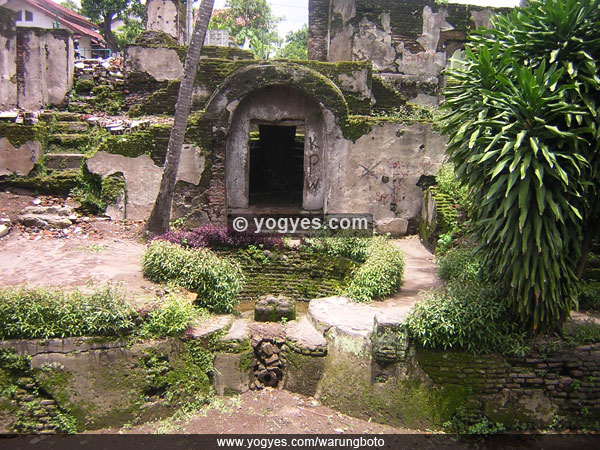
A very beautiful ancient water garden that was designed privately is found in Warungboto area. The water garden is located amidst the Pesanggarahan Warungboto that had ruined now.

Pesanggrahan Warungboto and the Enchantment of the 19th Century Water Garden

 When we pass by Jalan Veteran (the road directing to the right from the crossroad before Gembira Loka zoo) and see the ruins of a house-like building, we may neglect it as it looks like a common house building. Starting from now, however, we must know that the building is historical since it is one of the pesanggrahans built by Hamengku Buwono II.

The proof of it is that the name of the building is mentioned in one traditional Javanese song telling about Hamengku Buwono II. In that song, the building is not called pesanggrahan Warungboto as current people call it now, but it is named pesanggrahan Rejowinangun. The song itself in overall tells about the success gained during the reign of Hamengku Buwono II.

For some people, visit to this place will be boring, because there is no grandeur we can see. However, tourism does not always mean visiting luxurious places, does it? Simple places, even those that left only remains, must have an attraction. YogYES that visited this site a couple of days ago still found the beauty of some corners even though many parts of the building had been destroyed.

We began exploring the building from the front part or the one in direct border with the main road. This front part is of square shape with the floor made from something like cement. Located in front, this part possibly functioned as a hall or lobby as in modern buildings this time. From the front part, we can see the view of all complex of the pesanggrahan.

On the left side, there is a narrow, downward staircase. We could directly guest that the building of this pesanggrahan was of two stories like other buildings of similar pesanggrahan constructed of two floors. We have to be careful to go downward because there is no holding rail on both sides and much moss grow on most parts of it to make them slippery.

It is in this underground floor that we can see much of the enchanting parts of the building. The most beautiful part is the garden area that is completed with two ponds. The first pond is of circular shape with the diameter of 4.5 meters and the there is a water spring in the center of it. The second pond, on the other hand, is of square shape with the dimension of 10 meters x 4 meters. Those two ponds are adjacent one to each other with the connecting channel that can be seen clearly from the second pond.

We were astonished by the architecture of the pesanggrahan building when we are in this garden area. How could not we be so, the designer of this building that was built in 1800s had thought of the existence of a garden with very private pool, surrounded by other buildings to make it unseen from outside. Besides, the walls encircling it also looked high and thick, signaling the robustness of the ancient buildings.

To the north and south of the pond, there is a sufficient wide door of medium high. The door connects to other part of the underground space. In the east part of the pond, we will see three windows, one is of square shape and the other two are with arch shape on them. While in the west part of the pond, there is one door with an arch at the upper part, connecting to the next two arch doors equipped with some staircases. The last two doors connect the garden area underground to the ground floor.

Returning to the ground floor and explore the south side of the building, we will see the ruins of the wall. The wall was possibly the divider among the rooms in the pesanggrahan. There is unique part of the wall with its uneven surface that is predicted to have ornaments in the past. One robust wall still stands in the front part of the southern side. On the wall, there are square windows.

Actually, when Archeology Department arranged the place in 1980, there were still some ornaments. One of them should be the garuda statue in the south side, and a dragon statue in the east part and one flowerpot as a component of the pond. Unfortunately, YogYES did not find them even though we have explored each corner of the room. You might find one when you visit this location. We might be the only one who missed them!

To visit this place, there are some route alternatives. The easiest to take is when you leave from Kotagede. If we are on the way to Kotagede, we may pass by Jalan Kusumanegara until we get to the crossroad close to SGM milk factory, then we turn right. If we leave from Kotagede, we only have to take Jalan Ngeksigondo to the west direction until we get to Gambiran gas station and we turn right.

This pesanggrahan is relatively easy to reach and we do not have to pay anything to enter the location. One sure thing, when you make your tour to Yogyakarta you will feel to complete your visit if you have come to pesanggrahan Warungboto that used to be utilized by the family members of Ngayogyakarta Hadiningrat kingdom to meditate.

Text: Yunanto Wiji Utomo
Photo & Artistic: Agung Sulistiono Mabruron
English Translation: Emanuel, Downhill English Services

Copyright © 2007 YogYES.COM


More aboutWARUNGBOTO

KRATON

Posted by Unknown on Sunday, November 20, 2011

KRATON


Address: Jl. Rotowijayan 1, Yogyakarta 55133, IndonesiaPhone: (0274) 373 721
GPS Coordinate: S7°48'23.6" E110°21'50.6"

Kraton or the Palace where Sultan and his family of Yogyakarta live is located in the center of the axis stretching from the north to the south, and in the secondary axis from the east to the west. It is encircled by row of the mountains called the Horizon as the border of the universe.

KRATON - The Palace of the Sultan of Yogyakarta


It lies between Tugu as the north border and Panggung Krapyak as the south border, between Code River in the east and Winongo River in the west; between the Merapi Mountain and the South Sea. In the mind of the Javanese community, kraton is defined as center of the world that is described as center of the universe.
After the Giyanti Agreeement, Yogyakarta territory was given to Pangeran Mangkubumi. To run his governance, he built a palace in 1755 in Hutan Beringan area; such a good place flanked by two rivers that protect it from being flooded. The first king of Yogyakarta Palace was Pangeran Mangkubumi with the title Sri Sultan Hamengku Buwono I (HB I).

Naming and Meaning of the Lay Out

Karaton, Keraton or Kraton, originates from the word ke-ratu-an that means the place where the queen/king lives. Simple explanation of its broader meaning is that all structures and buildings in the Kraton area have significant meaning related to essential Javanese philosophy of life, namely Sangkan Paraning Dumadi that means the origin and the destination of human being.

In general, the Kraton area stretches 5 kilometers southwards to Krapyak village and 2 kilometers northwards until the Tugu monument. In this imaginary line, there is a reversed dualism linear line that tells symbolical philosophy: the direction from south to north symbolizes the birth of human being from the high place to the perishable world, and the opposite direction symbolizes the return of human being to the Dumadi (God in Javanese philosophy). Kraton is physical symbol and the King is the symbol of the real soul that presents into the physical body.

The direction from the Palace to the Tugu monument represents the road of life that is full of temptations. Beringharjo market symbolizes women temptation and temptation of power is symbolized by Kepatihan building. The straight street connecting the Palace to Tugu monument symbolizes close relationship between human being and the Creator (Sangkan Paraning Dumadi).

In short, Tugu monument is a symbol of lingga (male sex organ) and Krapyak symbolizes yoni (female sex organ) and kraton is physical blend of the two.


The Meaning of Yogyakarta Space Arrangement

 Hit by the earthquake in 1867, the Sultan Palace was severely damaged. During the reign of HB VII in 1889, the building was renovated. The lay out being retained, the shape of the building was changed to the current look.

Tugu monument and Manguntur Tangkil hall or Bangsal Kencana (where the king is seated), are straight in a line. This means that while sitting on his throne and looking toward the Tugu monument, he will always remember his people.

In general, the space arrangement of the current Sultan Palace is similar to the one of Mataram Dynasty. The center of the Palace is the so called Bangsal Kencana that is adjacent to Bangsal Prabayeksa as the place to keep sacred weapons (in this room, there is an oil lamp called Kyai Wiji that is kept lit by the Palace servants). This hall is surrounded by Kedhaton yard so that people must go through layers of the yard that seem like waves in order to reach the center.

This special arrangement of the Palace looks similar to constellation of mountain and Jambu Dwipa land that is considered to be central archipelago of the universe.

From north part to west part of the Palace area, there are North Square, North Siti Hinggil, North Kemandhungan, Srimanganti, Kedhaton, Kemagangan, South Kemandungan, South Siti Hinggil and South Square (the yard that is protected by high walls).

In order to reach all of the places, there are nine gates (called regol) that must be passed through, namely: gerbang, pangurukan, tarub agung, brajanala, srimanganti, kamagangan, gadhung mlati, kemandhungan and gading.

Brongtodiningrat sees the significance of this number, as the highest number to describe excellence. This is related to nine holes in human beings, commonly called babahan hawa sanga.

The sacredness of each Palace building is indicated by the frequency and intensity of Sultan activities in the location.

Sultan only visits the Square, Pagelaran, and Siti Hinggil three times a year, namely during the events of Pisowan Ageng Grebeg Maulud, Sawal and Besar and other very special, incidental events such as coronation of the Sultan and the crown prince or Pangeran Adipati Anom.

Yogyakarta Sultan Palace is an old building that was once damaged and restored. In general, it looks like other Kingdom buildings. When we understand the philosophy of them deeper, however, we will understand the symbolical meaning of life philosophy, human nature, how the nature works and human beings live their lives and various symbols of life existence in them.

Writer: R. Syah
Photo & Artistic: Sutrisno
Copyright © 2006 YogYES.COM
More aboutKRATON

KOTAGEDE

Posted by Unknown


Kotagede is a silent witness of the rise of the Islamic Mataram Kingdom that ruled almost the entire Java. The cemetery of Islamic Mataram Kingdom forefathers, the fort’s ruins, and the other historical remains can be found in Kotagede.

KOTAGEDE - Witness of the Rise of Islamic Mataram Kingdom (16th Century)


In the 8th century, the area of Mataram (now is known as Yogyakarta) was the center of Old Mataram Kingdom that ruled the entire Java. This kingdom had an extraordinary prosperity and civilization, so it had the ability to build ancient temples with an extravagant architecture, such as Prambanan  Temple and Borobudur  Temple. However, in the 10th century, with an unknown reason, the kingdom moved the center of the government to East Java area. The great numbers of citizens left Mataram and gradually this area became a woodland or forest.

Six centuries later, Java was ruled by The Sultanate of Pajang which is centered in Central Java. Sultan Hadiwijaya, who ruled in that time, gave Alas Mentaok (Mentaok Forest), which was very large in area, to Ki Gede Pemanahan for his achievement in defeating the enemy of kingdom. Ki Gede Pemanahan with all of his family and followers moved to Alas Mentaok, a forest that used to be the Old Mataram Kingdom.

The small village that was built by Ki Gede Pemanahan in that forest became prosperous. After the death of Ki Gede Pemanahan, his throne was replaced by his son who was titled Senapati Ingalaga. Under the rule of the wise Senapati, the village turned into a city that was more crowded and prosperous, therefore it is known as Kotagede (a big city). Afterwards, Senapati built an inner fort (cepuri) around the palace and an outer fort (baluwarti) that surrounded the area of ±200 acres. In the outside of these two forts, they are also equipped by a moat that was as wide as a river.

Mean while, in the Sultanate of Pajang there was a power struggle for the king throne after the death of Sultan Hadiwijaya. The crown prince that was known as Pangeran Benawa (Prince Benawa), was shoved aside by Arya Pangiri. Afterwards, Pangeran Benawa asked Senapati for a help since the Arya Pangiri’s government was judged to be unfair and disadvantageous to the people of Pajang. The war started. Arya Pangiri was conquered, but he was forgiven by Senapati. Then, Pangeran Benawa offered the throne of Pajang to Senapati, but he refused the offer politely. A year after, Pangeran Benawa passed away, but he had given a will that said Pajang must be ruled by Senapati. Since then, Senapati became the first king of Islamic Mataram and was entitled Panembahan. He didn’t want to use his title, Sultan, in order to honor Sultan Hadiwijaya and Pangeran Benawa. His palace was located in Kotagede.

Then, Panembahan Senapati expanded the area of Islamic Mataram Kingdom to Pati, Madiun, Kediri, and Pasuruan. Panembahan Senapati passed away in 1601 and was buried in Kotagede next to his father’s tomb. Afterwards, the Islamic Mataram Kingdom conquered almost the entire island of Jave (except Banten and Batavia) and reached the highest prosperity under the rule of the third king, Sultan Agung (the grandson of Panembahan Senapati). In 1613, Sultan Agung moved the central of the kingdom to Karta (next to Plered) and ended the era of Kotagede as a central of Islamic Mataram Kingdom.
The Historical Heritage

In the later development, Kotagede remained to be crowded although it was no longer as the capital of the kingdom. Many historical remains such as the cemetery of the kingdom forefathers, Kotagede Mosque, traditional houses with Javanese architecture, the topography of the villages or kampongs that using the ancient city’s system, and the fort ruins can be found in Kotagede.

    * Pasar Kotagede (Kotagede traditional market)

      The city system of Javanese kingdom usually places the palace, the roundabout, and the traditional market on the line that stretches from South to North. The Book of Nagarakertagama that was written in the era of Majapahit Kingdom (14th century), told that this pattern had been used since that time. The traditional market that had been there since the era of Panembahan Senopati, is still exist until now. Every legi morning in Javanese calendar system, sellers, buyers, and trading products are spread all over the market. The building has been renovated, but the position remains the same. If you want to explore Kotagede, you can start it from the traditional market by walking to the South heading the graveyard, the ruins of inner fort, and the fenced banyan tree.
    * The kingdom forefathers’ graveyard

      Walk 100 meters to the South of Kotagede Traditional Market, we can find the graveyard area of the Islamic Mataram Kingdom’s forefathers that is surrounded by a tall and strong wall. The portal to the graveyard area has the feature of Hindu architecture. Each portal has the thick wooden handle and is decorated with beautiful carvings. Some kingdom servants dressing up in traditional Javanese outfit guard the graveyard complex for 24 hours a day.

      We can pass through 3 portals before getting to the last portal that heads to the graveyard area. For getting into the graveyard area, we have to dress up in traditional Javanese outfit (it can be rented there). The visitors are only allowed to enter the graveyard on Sunday, Monday, Thursday, and Friday at 08.00 to 16.00. For honoring the Mataram Kingdom’s forefathers here, the visitors are not allowed to take pictures or bring a camera and wear golden jewelries inside the graveyard. The important people that were buried in here: Sultan Hadiwijaya, Ki Gede Pemanahan, Panembahan Senopati, and their families.
    * Kotagede Mosque

      The exploring of Kotagede will not be completed without visiting the Masjid Kotagede (Kotagede Mosque), the oldest mosque in Yogyakarta that is located in the area of the graveyard. Afterwards, you won’t be disappointed walking through the narrow passage way behind the wall around the graveyard area to see the architecture thoroughly and observe the daily activities of the people in Kotagede.
    * Traditional House

      Right across the graveyard area, we are able to see a Javanese traditional house. However, if you want to walk for 50 meters away to the South, you will be able to see a portal with a low hollow space and a sign that says "cagar budaya" (=cultural preservation). Get into the portal you will see some Kotagede Javanese traditional houses that are still preserved well and truly used as a place to live.
    * Kedhaton (The Royal Palace)

      Walking to the South a bit, you will see 3 banyan trees located right in the middle of the road. In the middle, there is a small building that is used for keeping the "watu gilang" (a special stone). It is a square-shaped black stone that has some written words on its surface. The written words are arranged in a circle-like shape. It says: ITA MOVENTUR MUNDU S - AINSI VA LE MONDE - ZOO GAAT DE WERELD - COSI VAN IL MONDO. In the outside of the circle, there are some words that say: AD ATERN AMMEMORIAM INFELICS - IN FORTUNA CONSOERTES DIGNI VALETE QUIDSTPERIS INSANI VIDETE IGNARI ET RIDETE, CONTEMNITE VOS CONSTEMTU - IGM (In Glorium Maximam).

      Inside the building, there is also "watu cantheng" (another special stone), three balls that are consist of yellowish stones. The local people had thought the stone "balls" were the toys of Panembahan Senapati. But there is also a possibility that the stones are the bullets of old cannons.
    * The ruins of the fort

      Panembahan Senopati built the inner fort (cepuri) completed with the moat around the palace, the area covered more or less 400x400 meters. The real ruins of the fort are still seen on the corner of Southwest and Southeast. The wall was 4 feets thick and made of stone blocks. The rest of the moat will be seen on the East, South, and West.

      Walking through Kotagede will enrich our knowledge about the history of Islamic Mataram Kingdom that was successful in Java. Furthermore, you can see local people’s daily routines closely. They have been staying inside the strong wall and doing the activities since hundreds years ago.

It is different with other places, the local people are so friendly with the Javanese characteristic, polite, and not too commercial. In Kotagede, you won’t be bothered by the hawkers who like to force people to buy their things. It’s a bit surprising, or pleasing will be the right word. Who miss the hawkers anyway?
More aboutKOTAGEDE

SURAKARTA HADININGRAT PALACE

Posted by Unknown on Tuesday, September 13, 2011

As one of the Javanese cultural sites, Kasunanan Surakarta Palace is still standing firmly as monument of glory of the old Javanese culture with a charming touch of Europe.
SURAKARTA HADININGRAT PALACE
Baluwarti Village, Kliwon Market District, Surakarta


SURAKARTA HADININGRAT PALACE

Old Javanese Palace with European Touch

Surakarta Hadiningrat Palace or later known as Kasunanan Surakarta Palace has been standing since hundreds of years ago. This palace is the "successor" of the Islamic Mataram Kingdom. After several times moving the palace from Kotagede, Pleret until Kartasura, pemberontakan kuning or the yellow rebellion by Chinese forced Mataram to move its palace to the village of Sala. Internal conflict and the Dutch intervention then divided this kingdom into Kasunanan Surakarta and Yogyakarta Sultanate in 1755 through Giyanti Agreement.

YogYES's journey began from the north gate of the palace, Gladag Gate. The gate is guarded by two statues of Dwarapala armed with cudgels. Down the road shaded by old Banyan trees on either side, YogYES arrived at the North Square. Like the typical style of an old town, Kasunanan Surakarta Palace is located in the same complex with the Square and the Great Mosque. A big Pendapa (traditional Javanese building) stands just across the square, while the main palace building is behind the Pendapa. Inside the main building, there's a museum that used to be an office complex in Pakubowono X reign. The museum is divided into nine exhibition halls contain various kinds of objects and heritage relics of the palace, traditional art diorama and the royal wedding ceremony complete with variety of equipments.

A narrow passage connected the museum with the main palace complex. To respect the customs and traditions, we are not allowed to wear shorts, sandals, sunglasses, and shirts without sleeves. We have to walk barefoot on the sand that said was taken from the South Coast. Sawo Kecik trees shaded the yard cooling down the air. In exegesis, the name of the tree is interpreted as a symbol which means sarwo becik or all good. The interesting fact is European statues that adorn the palace, creating a combination of ancient Javanese architecture and European touch. Those sculptures were gifts from the Netherlands who had very close relation with Kasunanan Surakarta. There is a tall tower on the south of the court named Panggung Songgobuwono, the landmark of this historical place.

Wanted to see more about the palace, YogYES asked a pedicab to drive around the entire palace complex. Sitting in a pedicab enjoying the palace neighborhood is such a different experience. Arrived at the South Square, we saw two old trains parked there, the King Cruise Train and a Hearse. But these trains are no longer functioned; the rail-track has turned into settlements. On the other side of square, a herd of white buffalo which known as Kyai Slamet buffalo were grazing. Those buffalos are considered sacred by the people of Solo and always paraded on Sekatenan Carnival and also carnival of the night of 1 Sura.

Copyright © 2010 YogYES.COM

Opening Hours
Monday to Thursday: 9:00 a.m. to 02:00 p.m
Saturday to Sunday: 09:00 a.m to 01:00 p.m

Ticketing
Ward Performances: IDR 2,500
Museum: IDR 8,000
Permission camera / video: IDR 3,500


More aboutSURAKARTA HADININGRAT PALACE

Luhur Watukaru temple

Posted by Unknown on Wednesday, July 13, 2011

Luhur Watukaru temple or Pura Batukaru  is one of the biggest Hindu Temples in Bali (Sad Kahyangan) with Catur Lokapala Temple and Padmabhuwana Temple status. It is set in the plateau area with lush tropical rain forest surround it. It is situated in the peaceful area which is far from the local resident that is ideally for worship. There are some temple building spread out through the tranquility of rain forest and the big mountain of Batukaru as a back drop.

Watukaru or Batukaru Temple is located at Wangaya Gede countryside, Penebel District and Tabanan regency, and west part of Bali Island. It is located right on the foot of Mount Batukaru and about 1.30 hours from Denpasar Airport.

The history of this temple is difficult to be found out even in the ancient omission exists in this temple. For example some profile area like harpoon own the Ancient Bali type, but no written data found it. The effort study and research of this temple history remain to find difficulties. The temple festival at Luwur Watukaru or Batukaru Temple is executed every six-month or 210 days which is every Thursday Umanis Wara Dungulan (Balinese Calendar), just the day after Galungan Day (the biggest Balinese Hindu Holidays). The extension day of temple festival is executed during eleven day, to give the opportunity for Hindu public society especially in Bali to come for praying. Pengempon (the society who take care of the temple) has the obligation to take care of the temple inclusive of ceremony execution. This fact is one of characteristic power outside of physical of Watu Karu Temple.
Kubayan is commissioned holy occupation lead the temple ceremony and his status higher than all priests in Pretending pertinent Ancient. In the execution of praying during the temple festival or the certain day ceremony, it has to be preceded by doing pray in Beji Temple which is located in eastside of Watu Karu Temple or inside of Madya Mandala (middle area) and Nista Mandala (outside area). After doing pray in Beji Temple, then the praying is continued  in the main temple building located in the center of temple area. This is also not need again clean the hand and gargle because, it has been conducted the hallowing of body by conducting pray in Beji Temple. This is specification of praying procession in Watukaru Temple.

The three elements temple area of Watukaru or Batukaru is equal to other temples in Bali generally which is consisted of outside area (Nista Mandala), Middle area (Madya mandala) and Center area (Utama Mandala). After refurbishing three temples are of this temple in some years ago, the element conception and structure of these three temple areas are progressively become everlasting and conceptual. This is especially in outside area where we can meet the existence of Wantilan building (Meeting Hall) which can be used for multifunction and it is located on the right of the entrance gate. The refurbishment at the parking area has made easy for the Hindu society or all tourists who pay a visit to this temple. It is also other public facilities like toilet which is located at outside temple area or the left side of entrance gate is in good condition and cleans enough. 

Since the government improves the public facilities at Watukaru Temple or Pura Batukaru and appointed as a tourist destination in Bali, nowadays many tourists from local and foreign countries has come to visit this temple area which is the cold atmospheres surround it. The rain forest is covering the temple area and gives the fresh air and deeply the religious nuance. It is the ideal places for meditation  and visited by religious  travelers. You can join Batukaru Temple Tour if you wish to visit this temple other tourist sites like Jatiluwih Rice Terrace and Tabanan Hot Water. 


More aboutLuhur Watukaru temple

Ulun Danu Beratan Temple

Posted by Unknown on Friday, June 24, 2011

 Ulun Danu Temple is a Balinese Hindu Temple located at Candi Kuning countryside, Baturiti sub district and Tabanan regency. The distance from Denpasar town is about 50 km north side the way from Denpasar to Singaraja. It is set at lakeside of Beratan with beautiful lake view and hills surround it. It is situated in the plateau area with cool atmosphere surround it and hills as a backdrop. We can find at north side of this temple is Pucak Sangkur mount, in the eastside there is Beratan Mount which also referred as Pucak Mangu or Pucak Pangelengan, in the south side there is Terate Bang Mount and in the Westside there is Tapak Mount and Watukaru Mount.

The name of Ulun Danu Beratan Temple is taken from the lake where the temple is built at Beratan Lake. The name of Beratan Lake is inseparable with the Beratan Mount as Deity and Goddess as fertility source, prosperity to keep the prosperity in life and society life. In papyrus chronicle of the Mengwi, this temple is referred as the name of Parhyangan ri pinggiring danu Beratan ( sanctum located in lakeside of Beratan Lake ). Ulun is come from Hulu word meaning head or power and in this case is intended by Ulun Danu Beratan means power of Beratan Lake that is Danu Goddess.  


* Lingga Petak Temple owns the function to worship the Siwa God
* Penataran Pucak Mangu Temple is referred this gate as Parhyangan ri pinggiring rawa Beratan or Danu Beratan Temple is founded by I Gusti Agung Putu to worship the Hyang ing Parwata or Deity which is placed in Pucak Mangu that is Bhatara Hyang Danawa as according to papyrus of Padma Bhuwana and Usana Bali, because Mangu Mount is located in north direction, hence it is called the Bhatara Hyang Danawa or Wisnu God
* Terate Bang Temple is functioning to worship of Brahma God
* Dalem Purwa Temple is functioning to worship of Danu Goddess which is considered to be miraculous of the Bhatara Hyang Danawa or Laksmi Goddess.

In Papyrus Chronicle of the Mengwi is elaborated by the history of Ulun Danu Beratan Temple founding together with existence of the Mengwi Empire. Therefore its status is pertained with the secondhand of Temple Empire what is usually pertained as Dang Kahyangan. It is the same to the description in papyrus of Usana Bali and Padma Bhuwana, hence Puncak Mangu Temple where the Panyawangan (representative place to worship) is the Ulun Danu Beratan Temple. So it is called by entire Balinese residents as Kahyangan Jagat (The Biggest Group of Hindu Temple in Bali )


The temple ceremony execution at Ulun Danu Beratan Temple is consisted of two types those are:
  • The temple ceremony which is executed every six-month (210 days) that on Anggara (Tuesday) Kliwon Julungwangi (Base on Balinese Hindu calendar). Every 12 months (420 days) is executed by the bigger ceremony from the ordinary ceremony, so-called Piodalan Agung
  • Pakelem ceremony is executed at any times as according to situation and condition. The Pakelem ceremony owns the function to worship the supremacy and also cheapness of the infinite for award of life, fertility, prosperity, as impact of the existence of ecosystem balance so that give the benefit for life and universe life forever and ever, during Beratan Lake and Beratan Mount stand up
If we look into the location, this temple is located in Beratan lakeside and it was the unique Bali Temple which are now many tourists paying a visit to this place. It is situated in the plateau area and surrounded by cold weather and owns the magnificent view which makes impression for every visitor. It is strategically located beside the main road from Denpasar to Singaraja. It is very easy to locate this temple by following the main road with the good access. You may also join Bedugul Tours or Singaraja Tour to visit this beautiful temple. 
More aboutUlun Danu Beratan Temple

Beratan Lake (Bedugul)

Posted by Unknown on Sunday, June 5, 2011


Beratan Lake is a shallow lake with the high caldera about 1231m above sea level and it is located at Bedugul, the famous tourist destinations in Bali. This lake have wide 3,8 km2 and also its deepness is up to 22 meters. The water volume in this lake is about 0,049 km3, so Beratan Lake is the closed lake. Tourist can access the Beratan Lake through the dock which have been provided or desist around Ulun Danu Beratan Temple. In this place, the visitor  can do various activities like doing recreation  to look around in dock or do the other outdoor  activities. The various water recreation activities can also be conducted here, for example riding the boat motorize to circle the lake, parasailing, canoeing with the traditional boat, banana boating, water skiing, and others. Fishing activities are also available in this places for who one love fishing in the lake.

Beratan Lake is situated in the plateau area with cool atmosphere surround it. It is an ideal place for relaxation while enjoy the beautiful panorama of lake. The accommodations are also available in this area where is the perfect place for overnight stay, resting and enjoy the beautiful panoramic of lake with the Ulun Danu Temple as a magnificence. The small scale of agriculture activities are likely conducted around this lake and can be perceived at the same time circle around it. If we encircle it, we can take photograph with the beautiful background view or make the picture sketch face in painting mini studio at the lakeside with a short time as a souvenir.


If the tourist paying a visit to the Beratan Lake, they also can visit other places of interest in Bedugul Tabanan Bali  nearby like Bedugul Botanical Garden or Kebun Raya Eka Karya where the visitors can relax while enjoy the various of flora types, traditional Balinese  houses and others. Candi Kuning Market  is a Traditional Vegetable and Fruit Market located at Candi Kuning countryside which can be reached only in a few minutes from the lake. Various fruit type, vegetables and also mace can be bought here with many choices. It is not far from Ulun Danu Temple. Buyan Lake and Tamblingan Lake are the next places of interest existing near the Beratan Lake and it is just 3 minutes drive by car from this place. Beratan Lake can be reached easily from the main road from Denpasar to Bedugul and it takes about 2 hours from the town with the good road access. You may also visit this area by joining the exciting Bedugul Tours or Singaraja Tour.

More aboutBeratan Lake (Bedugul)

Batubulan Village

Posted by Unknown on Friday, May 27, 2011


Batubulan is an artistic  countryside in west part of Gianyar regency. The identity and image as an art  village, Batubulan has been famous in Indonesia and all over the world which has been built based on an artistic blessing dance of Barong (Barong and Keris dance). Barong Dance  is daily performed at five different stages in this countryside, like Puseh Temple Stage, Tegal Tamu Stage, Denjalan Stage, Sahadewa Stage and Sila Budaya Stage. The fascination of this Tourism Cultural Object is from variety of quality artistic potency. Batubulan Village is covering the dance art, artistic of Kerawitan, artistic of idol and article art. 


The beginning of Batubulan Village is an agrarian village which is sustained by carves the ledge stone. Relying on artistic potential, strategic location and open village network by local, national, and global, then this village grows as tourist  destination which is popular with Tourism Cultural Object. Entire Bali  Tour Packages to Middle of Bali  or east part Bali are started from Batubulan Village . Batubulan Bus Station is strategically located as node communications to seven towns in Bali  those are Denpasar, Badung, Gianyar, Bangli, Klungkung, Karangasem, and Singaraja. Batubulan is the opener relationship to reach the network entire of Bali Island . This village is located 8 KM from Denpasar town and it is consisted of three custom countryside, those are: Desa Adat Tegal Tamu, Desa Adat Jero Kuta and Desa Adat Delod Tukad. It is coming within 16 Banjar demographically, this village is pertained by an overpopulated village with the amount of the year resident 2003 equal to 11.333 people by 2.775 family. The name of Batubulan is etymologically taken from two word that are: Batu and Bulan (moon stone). Pre-eminent tourism sites and especial fascination of Batubulan Village in map of Bali Tourism are Barong Dance  and stone carving art. This Tourist destination is become more famous because sustained by tourism  fascination non-stopped expand and immeasurable. As a tourism object and stone carving business area, Batubulan village is visited by tourist of foreign countries and domestic since in the morning time until evening time. At 09:00-10:30 am daily, Barong Dance is held while at 18:00-19:00 pm, the Kecak Dance or Bali Night performances are executed.
More aboutBatubulan Village

Mas Village

Posted by Unknown on Monday, May 16, 2011


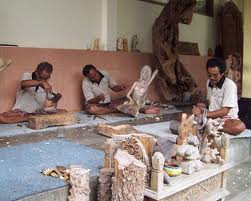
 Mas Village is one of villages in Bali fundamentally identified as an artistic countryside by focusing in artistic of wood carving. Mas Village is located in Ubud sub district and Gianyar Regency, east part of Bali. It owns the typical style of wood carving art by placing forward the distinguish synergy the humanism and naturalism. The village's popularity as an art village is famous in the national and world level which is not forgetting from the highness name of some maestros which has borne and found the spirit (taksu) and soul. The famous maestro who was borne in this village is Ida Bagus Tilem.

This Artistic countryside owns the long history root. The result of wood carving art in this village owns the immeasurable and wide dimension like idol for the devoting (arca idol), representative dimension of everyday Balinese social society life (farmer, fisherman, worker, intellectual, merchant etc), the abstract dimension as existing of actor imagination which is listening carefully of reality, dynamics and life philosophy. The villagers are same as villagers at other tourism countryside in Bali that have also experienced the transformation from agrarian society to the crafting society. Even nowadays, it is continued to service society from commerce service until levying service of the souvenir for overseas and domestic tourist. 

It is strategically located in the main road from Denpasar to Ubud and it can be reached from various of angle. It is about 15 km easterly go to the majors road to Ubud from Denpasar town. If you wish to go to this place from Denpasar, the starting spandrel points step into Mas Village is Sakah, where a big baby idol monumentally existing in the middle of road. The Baby idol is a symbol and representative of human being life early which is believed by local residents with full of philosophic value, religious and dynamism.
More aboutMas Village

Tabanan Hot Water

Posted by Unknown on Wednesday, May 4, 2011


Tabanan Hot Water is one of tourist destinations  in Tabanan regency, west part of Bali. it is about 15 minutes from Tabanan town and close to Batukaru Temple. It is set on the hill bank and the river valley just in front of it. There is a main pool located in the lowest level and just beside of river meanwhile other small pools are set on the bank. This hot water is come from the Batukaru mount and flows to the hill bank at Penatahan village, the location of Tabanan Hot Water.

It is located in Penatahan Village, Penebel Sub district and Tabanan Regency. It is about 1,5 hour drive from Bali's International Airport taking the simple direction to go to Tabanan Town and access to Batukaru Temple. It is strategically located beside of main road from Tabanan town to Batukaru Temple.

Tabanan Hot Water is a potential place as tourist destination in Bali  due to the place is unique with original hot water located in the river bank. We can find a hotel, restaurant and small spa in this hot water that completing this area a tourist destination in Tabanan Regency. It is many visited by local and foreign tourists  who want to take a bath in the hot water while enjoy the natural nature surround it.
More aboutTabanan Hot Water

Kawi Mountain

Posted by Unknown on Tuesday, April 12, 2011

 Gunung Kawi is a Hindu Temple  complex with old omission from the stone era located in Gianyar regency. Based on the inscription of Tengkulak A on 945 saka (Balinese calendar) which is released by Marakata King, the ancient omission complex is located at the Pekerisan River then it is called Katyangan Amarawati. Pekerisan River is also named by Jalu which is according to the inscription chiseled on the above of the biggest temple door sound ‘Haji Lumahing Jalu'. The name of Gunung Kawi is the name given on the omission which is related to the complex of temples because the temple on this area is like the symbol from the mount. There are 3 temples which so called the name as Gunung Kawi in Bali  those are Gunung Kawi in Sebatu countryside, Gunung Kawi Temple in Keliki countryside and Gunung Kawi Temple in Babitra countryside. The ancient omission complex of Gunung Kawi is founded on 10 century. It is founded in the era of Udayana about 989 M. At the period of Marakata governance on 1023, the omission which is called Katyagan Amarawati is developed and continued by the governance of Anak Wungsu which is guess lead between the years of 1049 - 1077 M. 


Consisted of 2 types Temple:

  • Temple Complex.
    Temple complex is consisted of 2 consecutions. The consecution in eastside Pekerisan River is consisted of 5 units and the consecution at west side of river is 5 units, in the north is 4 units and 1 unit is located far in south side separate from the others. On the above of the temple consecution in particular to the Eastside River, there is an article of Kediri word type sounding ‘Haji Lumahing Jalu'. Haji means a king, the Lumah means a temple or Sidha Dewata means to return to the nature of deity and Ing Jalu means in Pekerisan. The Jalu mean the Keris literal. The entire words mean that king is made in temple form at Pekerisan. From this article is assumed that this temple is dedicated to Udayana King which is also called Marakata and Anak Wungsu. The temple which is located in the west side of river related to all king concubines. The temples are located far in the south side is attributed to prime minister because in these temple areas existing an article Rakyan which is namely perform for high functionary of empire.
  • Buddhist Temple Complex
    Buddhist Temple Complex is used as a residence and as place for meditation. It is consisted of some nooks and it is located in the cross east of Pakerisan River. Other nooks are located spread out and near the temple bunch.

Gunung Kawi is a famous tourist destination in Bali with its ancient omission so that this place is the right to visit during your vacation in the island.
More aboutKawi Mountain

Ubud Palace

Posted by Unknown on Sunday, March 27, 2011

 Puri Saren Ubud (Ubud Palace) is an Ubud Kingdom Palace with beautiful Balinese traditional houses as a residence of Ubud King. It is set in the center of Ubud Bali with traditional art market just in front of it and it is found by Ida Tjokorda Putu Kandel who has commanded from year 1800 - 1823. This palace is an artistic cultural life center, while the traditional market is the symbol of local economics resident. The existence of Puri Saren as a palace is equipped by a Wantilan/auditorium that is a large building of meeting room and a banyan tree as shelter place at the daytime. The traditional market is the place of society economics and its existence is always border on palace as artistic cultural life center. It means that the both pole meeting is describing the dynamics of society and kingdom life.

The tourists who purchase the tour package to Ubud will visit this place and they will feel not complete if they are not invited to visit the Puri Saren (Ubud Palace) and traditional market, because both of these tourist destinations are the soul and identity of Ubud Village itself. The palace is very beautiful with artistically traditional building and contains the high esthetics value. It is situated in the good temperature which can give the ruthless and freshness for every visitor. Some world class painters from Europe have lived in Ubud like Rudolf Bonnet, Walter Spies, Arie Smith, Antonio Blanko, Hans Snell and others. These entire world class painters through its painting masterpiece have indirectly followed to promote Bali Tourism because theme or their painting objects are about the culture and nature of Bali. Ida Tjokorda Agung Sukawati has exploited his palace as lodge place for his entire respectable guest


In the year 1928, the Tjampuhan Hotel is founded for all empire's guest and on 1934, this hotel is opened as a lodge for empire's guest and also used as a center place of Pita Maha Organization Activities. Tjampuhan Hotel is an eldest hotel in Ubud with the traditional style. In growth hereinafter, Ubud as a tourism destination is one of tourist area in Gianyar Regency own separate specification.

More aboutUbud Palace

Taman Ayun Temple

Posted by Unknown on Tuesday, February 8, 2011


Taman Ayun Temple is a Royal Temple of Mengwi Empire and it is located in Mengwi Village, Mengwi sub district, Badung regency and about 18 Km north side of Denpasar town. It is strategically located beside of major roadway between Denpasar to Singaraja. It is set on the land which is surrounded by the big fish pond and look like a drift on the water. It owns the beautiful temple building with multistoried roof and Balinese Architecture. The wide beautiful landscape garden in front courtyard to welcome all visitors who come and visit this temple. It is a beautiful place to visit on your vacation in Bali.

Pursuant to Papyrus Chronicle of the Mengwi (Lontar Babad Mengwi), the temple which is now referred by Taman Ayun Temple that it had been newly sanctified in the year 1634 M and it is named with Taman Ahyun Temple. The word of Ahyun is coming from from the root word Hyun meaning a temple is founded in the park (pool with the beautiful garden) which can fulfill the desire. The word Ahyun is then changed into Ayun word. Taman Ayun Temple is one of Hindu Temples in Bali become tourist destination which has been visited by many tourists from local and foreign. This temple is usually visited by tourist once having a set tour to Tanah Lot Temple due to this temple is the same route of the Tanah Lot Temple Tour


The function of Taman Ayun Temple is a place to pray the god in their manifestation. It is according to the content of Babad Mengwi and the existence of temple building structure, especially the temple that is located in third area (Jeroan). According to Astadewata, the special God is worshiped in Taman Ayun Temple is the God in manifestation as a Wisnu God which his palace located in top of Mangu mount. In papyrus of Usana Bali mentioning that one of Dewa Catur Lokapalas carry through its worship is Meru Pucak Pangelengan that is a temple building with 9 multistoried roofs. Pitara God is a holy soul deity of ancestor who is also referred as the other names of Hyang Pitara or Dewa Hyang. Pitara God is obliged to be worshiped by clan heir (Prati Sentana) in the form of temple ceremony which the same meaning as by the ceremony to the god. The worshiping existence to Pitara God in Taman Ayun Temple can be searched and proved by pursuant to the existence of temple building which lay in by consecution in east which is called Paibon that is representing Special Temple. Taman Ayun Temple in capacities or its status as special altar for the King family of Mengwi Palace or as a Merajan Agung from Mengwi King Families specially for the founder of Mengwi Empire that is I Gusti Agung Putu.
More aboutTaman Ayun Temple

Tanah Lot Temple

Posted by Unknown on Sunday, January 2, 2011


Tanah Lot Temple is located in coastal side of Beraban countryside, Kediri sub district and Tabanan Regency. It is situated in 30 Km in west side of Denpasar town and about 11 Km in south side of Tabanan town. The temple is built on the rock with 3 acre size and reachable in a few minute by walk, because it is just 20 meters from the coastal lip. This temple is very famous among tourist destinations in Bali with spectacular view of sunset. At some nooks of coral reef  around Tanah Lot Temple there are holy tame snake in black and white color where according to the local society believe that it as a deity property and as the guard of the temple from the bad influence.

The word of Tanah Lot is consisted of two words that are Tanah word interpreted as a reef looking like gili or isle. Lot or Lod word has meaning the sea. So Tanah Lot is meaning the small island floating on the sea. The location is now called as Tanah Lot has been used at a Megalithic period as a place that looked into holy, proven from the existence of menhir. Pursuant to environmental condition, hence the structure of Tanah Lot Temple is built at irregular reef plain of its angle which is only consisted of one plain yard as Jeroan.

The function of this temple can be realized from the function of the main temple building which is located in the temple main area. In this place, there is a main temple to worship the god in form of Dewa Baruna or Bhatara Segara, the sea power. The media of worship to this god is the temple building with 5 storied meanwhile the 3 storied temple building in north part of this area is purposing to worship to Dang Hyang Nirartha. 


In order to know the status of Tanah Lot Temple can be realized from the temple history, function and also incoming devotee existence pray when temple ceremony is held. In this case can be realized as follows:

  • Tanah Lot Temple as dang Kahyangan (the big Holy Temples in Bali ), because the history and the  Penyiwi (The people taking care of the temple) are from the local people from Tabanan regency and surrounding area

  • Tanah Lot temple as Segara Temple, because its function as sanctum to worship the Bhatara Segara, the God with manifestation as the ocean Power Deity

The unique animal can be seen in this temple area is the snake which are generally can be met in the coast. Part of its stomach there are no athwart skin, there is only small skin, but this sea water snake very noxious but snakebite case are very seldom happened, because the sea water snake generally very passive.

As a favorite tourism destination in Bali, Tanah Lot owns a magnificent view in particular at the sunset time where the sun slows down to the earth stomach. Every visitor who is paying a visit to this place will be marveled to see the beauty panorama of Tanah Lot. Beside of this temple, there are other temples which can be seen on your visit to Tanah Lot like Batu Bolong Temple, Batumejan Temple and Enjung Galuh Temple.

More aboutTanah Lot Temple

Bedugul Botanical Garden

Posted by Unknown on Thursday, December 23, 2010


 Bedugul Botanical Garden or Kebun Raya Eka Karya is the huge tropical garden located in Bedugul, plateau area in Bali. It is situated in the cool atmosphere with rain forest and hill surrounds it. This botanical garden is opened on 1959 and owns 154,5 ha land located Tabanan regency, northwest part of Bali. It is close to the beautiful lake which is called Beratan Lake and Ulun Danu Temple. It is completed by more than 1187 plant types and multifarious of floras. In this area, there is orchid garden with the collection of 320 orchid types from Bali, Java, Nusa Tenggara Timur, Sulawesi and also Irian Jaya. We can also meet the rose garden with the collection of various rose from rust colored until green chromatic.

Bedugul Botanical Garden or Kebun Raya Eka Karya is also completed by 524 birches which are still in its original forest. In this place we can meet the collection from America, South America, China, Japan, Australia, Africa and also Netherlands. Cyathea Garden is one of the specific gardens owning the various collections of Paku-pakuan (tropical vegetable) which can be eaten as vegetable by Balinese and some of them are used for decoration. The tree from this nail Cyatheas are often exploited as growth media of various orchid types. Cactus collections are consisted of 104 types. This cactus is obtained from Africa, America, Germany, Switzerland and also Indonesia. The crop season at botanical garden is taken 94 types plants that are the collection from the exploitation for Balinese life ceremony, temple ceremony, devoting / offering and others purpose. It also owns the collection of drug crop with 84 types / species. 


Beside of the crop collections, Bedugul Botanical Garden or Kebun Raya Eka Karya also owns the traditional Balinese houses and it function as guest house for scientist who is doing observation. It is also opened for public including tourists and to be one of favorite tourist destinations in Bali especially for domestic tourists. The most crowded visitors at this place are on Lebaran Period (Moslem holiday), Balinese Holidays, National Holidays and New Year period.

More aboutBedugul Botanical Garden

Celuk Village

Posted by Unknown on Tuesday, December 14, 2010


Celuk Village is the famous village in Bali as a tourist destination cause of the local residents is very proactive and full of innovation to the gold and silver crafting. This countryside is located in sub district of Sukawati, Gianyar Regency and owns the individuality and excellence in production of gold and silver crafting. Most of them are Balinese professional, artistic and skillful of design development related to the silver and gold crafting.

The productions of gold and silver at this village have penetrated to the local, national and international market. It can be measured from the type of artwork result and variation of ornament, good as present and also export commodity. The type of gold and silver craft has been produced in this countryside are covering various of rings, bangles, chokers, earrings, mother of pearls, Tusuk Konde, broach and other types. Beside of that, Celuk's workers are able to response the market demands and produce the modern product like medal, maket and culture symbol. In spanning of artistic growth history, the silver and gold crafting had been started by a group of family pertained by Clan Pande. From this family circle, the activity of gold and silver crafting has disseminated to entire society as a top profession which are previously as the farmer. In year 1970's decades, it has been happened the change of countryside society culture significantly from agrarian society structure to industrial society structure of crafting. Even nowadays, some of them have jumped again to the economic structure of service by focusing in tourism industry. The change and jumping movement of these structures have brought the new positive impact for prosperity. Celuk Village, Kuta and Ubud are the prosperous countryside in Bali by the higher resident's income cause of tourism.  


Celuk Village is strategically located in main road from Denpasar to Gianyar regency which is about 5 km from Denpasar town. The next door villages are Batubulan Village which is famous of Barong dance and stone carving, Singapadu Village with the art village equipped by places of recreation such as Bird Park and Bali Zoo Park, Batuan Village with the traditional painting, Guang village with the wood carving and Sukawati as a center of art market. Along way of Celuk Village about 2 km, we will find in the left and right side the various type of gold and silver shop which are opened to the domestic and international tourist. It is also inside of this village, we will find the activities and workshop of crafting which are ready to be ordered in small or huge number.
More aboutCeluk Village

Ubud Village

Posted by Unknown on Saturday, October 30, 2010

 Ubud Village is a traditional village supervising 13 Banjar (group of community) and 6 custom countryside. It is located in Ubud sub district, Gianyar Regency  and about 20 km from Denpasar Town. Ubud Vilage can be reached within 30 minutes or 15 minutes from Gianyar Town and this place is situated in the high land about 300 meter above sea level. Ubud is surrounded by the good temperature compare with other regions in Bali where the temperatures are relative cool that is ideally for everyone to stay in this beautiful place. This village is occupied 9.800 peoples which most of them are Hindu. They able to keep the environment naturally so that way this place usually used by many tourist/people/actors to get the art inspiration.

Ubud Village is also well known as a culture village where we easily find the local community presenting traditional cultures from the ritual up to the traditional dance performances. This village own the rich culture with the history heritage of all big actors, especially all famous artists, for example I Gusti Nyoman Lempad (1862 - 1978), Anak Agng Gede Sobrat (1919 - 1992), I Gusti Made Deblog (1910 - 1968), afterward caught up by others like, I Gusti Ketut Kobot, Ida Bagus Made, Dewa Putu Bedil, Ida Bagus Rai and others. The popularity of all above artists follows to give the inspiration to all west artists to live in Ubud Bali. In year 1920's, two European artist people that are Rodolf Bonnet from Dutch and Walter Spies from Germany inscribe the new history of artistic growth paint the countryside of Ubud. Second, the European artist introduce the European esthetics technique especially illumination area, shadow, perspective and anatomy. All local artists permeate the new technique matching with value and base on local mind fixed take the traditional so that able to give the separate identity by the name Ubud. Ubud Village progressively famous as a born area of all painters because the existence of the cooperation between Tjokorda Gede Agung Sukawati and Rudolf Bonnet to form the Pita Maha. Pita Maha represent a place to discuss the artistic growth and problem paint, and also to compare mind to each other and introducing result of art which they own.  


Ubud Village Tour is an exciting tour package to visit places interest in this village and surrounding area. There are other Ubud Tour Package available which all of them visit this village like Elephant  Ubud Tour, Rafting Ubud Tour , Elephant Safari Ubud Tour and Ayung Rafting Ubud Tour .

Ubud is one of tourist places in Bali provides many hotels from luxury until the low budget. We can recommend the following hotels in Ubud which you can select one of them based on your budget:

  • Maya Ubud Resort
  • Cendana Resort
  • Ubud Village
  • Agung Raka Bungalow
  • Villa Semana
  • Natura Resort
  • Barong Resort
  • Ibah Hotel
  • Pita Maha
  • Royal Pita Maha
  • Kupu - Kupu Barong
  • Kra-Chaai Villa
  • Begawan Giri
  • Komaneka Tanggayuda
  • Komaneka Resort
  • Alila Ubud
  • Ubud Village
  • Alam Puri Villa
  • Teba House
More aboutUbud Village